Water is easy to take for granted. It comes from the tap, fills the kettle, runs through the washing machine, and disappears down the drain. Most days, we don’t give it a second thought. But when water starts leaving chalky marks, tasting strange, or making showers feel less comfortable, suddenly it becomes very noticeable.
The tricky part is figuring out what to do about it. There are countless water treatment products available, and each one seems to promise something slightly different. Some focus on hardness. Others target taste, odor, dissolved substances, or specific contaminants. Choosing wisely means looking past the sales language and starting with the needs of your home.
There isn’t one perfect system for every household. And honestly, that’s a good thing.
Start With a Water Test
Before choosing equipment, find out what you’re actually dealing with. Water can look perfectly clear while containing minerals or other substances that affect how it behaves around your home.
Hardness is one common concern. Calcium and magnesium can create scale on faucets, shower doors, water heaters, and appliances. Other homes may have concerns involving chlorine taste, sediment, iron, sulfur odors, or different water-quality characteristics.
Testing gives you a baseline. Instead of choosing equipment because a neighbor has it or because a product happens to be popular, you can make the decision based on your own water.
It’s a small step, but it can prevent a surprisingly expensive mistake.
Understanding Reverse Osmosis
For homeowners particularly concerned about drinking-water quality, reverse osmosis systems are one treatment option worth understanding.
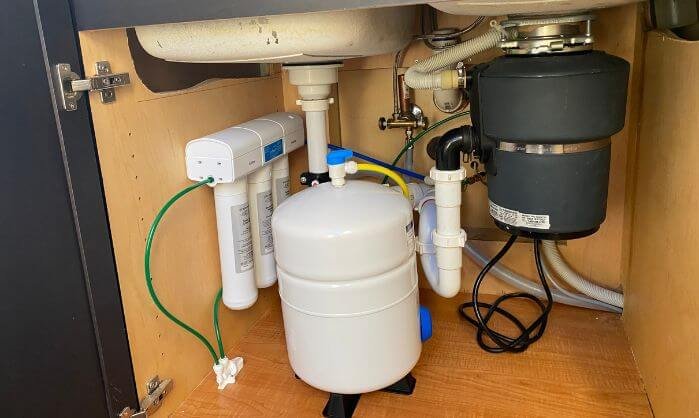
Reverse osmosis uses a semipermeable membrane to separate water from many dissolved substances. A properly designed system can reduce a broad range of contaminants, depending on the membrane, prefilters, water conditions, and overall system configuration.
RO systems are often installed at a dedicated drinking-water point, such as the kitchen sink. That can be useful when your primary goal is highly treated water for drinking and cooking rather than treating every gallon entering the house.
There are trade-offs, though. RO systems typically produce some reject water during filtration, and membranes and prefilters need periodic replacement. Good maintenance is part of getting consistent performance.
Hard Water Needs a Different Solution
If your main frustration is mineral scale, an RO system may not be the answer for the whole house.
This is where water conditioners & softeners come into the conversation. Traditional water softeners are designed primarily to reduce hardness minerals, while other conditioning technologies may work differently and have different goals.
Softened water can help reduce scale formation and make everyday cleaning easier. You may notice less residue around faucets, better soap lather, and fewer mineral deposits on certain fixtures.
Still, it’s worth understanding exactly what you’re buying. “Conditioner” and “softener” aren’t always interchangeable terms, and technologies can vary considerably.
Ask what the system is designed to change in the water. That’s much more useful than simply asking whether it is “the best.”
Whole-Home or Point-of-Use?
This is one of the most important decisions homeowners face.
Point-of-use systems treat water at a specific location, usually where drinking or cooking takes place. Whole-home systems treat water as it enters the property, meaning treated water can reach multiple fixtures.
Neither approach is automatically right for everyone.
If your biggest concern is drinking-water taste, a kitchen filtration or RO system may be enough. If hard water is affecting showers, laundry, appliances, and plumbing throughout the property, whole-home treatment may make more sense.
The key is matching the treatment location to the problem.
Think About Maintenance Before You Buy
A treatment system isn’t a set-it-and-forget-it appliance.
Filters need changing. Salt-based systems need supplies. RO membranes eventually require replacement. Valves, fittings, tanks, and controls may need inspection.
Before purchasing anything, ask what routine maintenance looks like. How often do filters need replacement? What does a typical service visit involve? Are replacement parts easy to obtain?
These questions may not be exciting, but they matter. A system that looks affordable initially can become frustrating if its maintenance requirements are difficult or expensive.
Don’t Overlook Drinking-Water Convenience
There’s another side to water treatment that has less to do with contaminants and more to do with daily habits.
In offices, businesses, schools, and even some larger homes, people may want convenient access to chilled drinking water without constantly buying and storing plastic bottles.
That’s one reason bottleless coolers & dispensers have become an option worth considering. Instead of relying on delivered bottles, these systems connect to a water supply and typically use filtration to provide convenient drinking water.
For a workplace, the practical advantage can be significant. There are fewer bottles to store, fewer deliveries to coordinate, and less physical handling.
The right filtration setup still matters, of course. A dispenser isn’t a substitute for understanding the quality of the incoming water.
Consider Your Household Habits
Technology only helps when it fits real life.
If you have a busy family, you may care more about system capacity and easy maintenance than about advanced features you’ll never use. If you’re frequently cooking at home, drinking-water quality may be a bigger priority.
Someone living in a small apartment has different needs from a homeowner with several bathrooms and high water consumption.
Take a normal week and think about how your household uses water. Showers, laundry, cooking, drinking, dishwashing, appliances — it all adds up.
This simple exercise can make system selection much easier.
Installation Matters, Too
Even the right equipment can disappoint if it’s installed poorly.
Water pressure, pipe size, drainage, electrical requirements, available space, and plumbing configuration all deserve attention. Equipment should also be positioned so that filters and other components can be reached later.
Professional installation can help ensure the system is properly connected and configured. It also gives you an opportunity to ask questions about operation and maintenance before the installer leaves.
Don’t be shy about asking questions. You’re the person who will live with the system every day.
Look at the Long-Term Picture
A smart water treatment decision isn’t necessarily the one with the most features.
It’s the one that solves a genuine problem without creating unnecessary expense or maintenance.
Start with testing. Identify the main issue. Decide whether you need point-of-use or whole-home treatment. Compare technologies based on what they actually do, and consider installation and ongoing care alongside the equipment price.
And give yourself a little time to decide. Water treatment isn’t usually an emergency purchase.
Better Water Should Make Life Simpler
The best treatment system is one you barely notice after it’s installed. It works quietly, fits into your routine, and addresses the water-quality concerns that matter to you.
Maybe that means less scale around the shower. Maybe it’s better-tasting drinking water. Maybe it’s simply the convenience of having treated water available without constantly thinking about it.
Whatever the goal, start with facts rather than assumptions. Understand your water, understand the technology, and choose equipment that fits your home and habits.
That way, you’re not just buying a water treatment product. You’re creating a more comfortable, practical water setup — one that makes everyday life a little easier without making things unnecessarily complicated.