There’s something appealing about keeping things simple. If the water coming from your kitchen tap doesn’t taste quite right, you don’t necessarily need to rethink the entire plumbing system. Sometimes, the most practical answer is to focus on the water you actually drink.
The kitchen is where water becomes part of coffee, tea, cooking, ice, smoothies and, of course, that glass you reach for several times a day. When taste or quality is a concern, treating water at the point where it’s consumed can make a lot of sense.
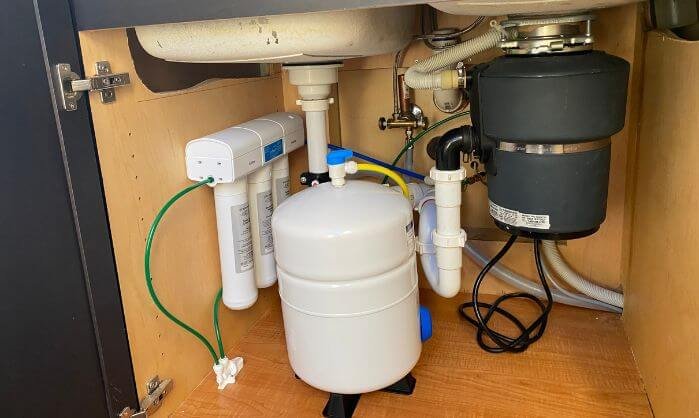
An under-sink filtration system is one way to do exactly that. It stays mostly out of sight, doesn’t take over your countertop, and can provide treated water through a dedicated faucet. But before choosing one, it helps to understand what these systems can actually accomplish.
Why Point-of-Use Treatment Makes Sense
Not every gallon of water entering a house needs the same level of treatment.
You don’t necessarily need highly treated water for flushing a toilet or watering the garden. Your priorities may be different for water used to drink, cook, or prepare food.
That’s where under-sink drinking water systems can be useful. They focus treatment on a specific point of use, allowing homeowners to address drinking-water concerns without installing equipment throughout the entire property.
This approach can also reduce unnecessary equipment and maintenance. Instead of treating hundreds of gallons for every household activity, you’re treating the portion of water that matters most to you.
Of course, whether it’s the right choice depends on what’s actually in your water.
Start by Finding Out What’s in the Water
It’s tempting to choose a filter based on a general promise of “cleaner” water.
But cleaner according to what?
Water can contain naturally occurring minerals, sediment, chlorine, microorganisms, or other substances depending on its source and local conditions. Some are harmless but affect taste. Others may require specific treatment.
Testing helps separate the facts from assumptions.
A water-quality test can provide information about hardness, pH, iron, manganese, chlorine, sediment, and other characteristics. The appropriate test depends on the source of the water and the concerns you are trying to investigate.
Once you know what’s there, choosing treatment becomes much easier.
What Are Dissolved Contaminants?
One of the reasons reverse osmosis is often considered for drinking water is its ability to reduce many dissolved contaminants.
Unlike larger particles, dissolved substances can pass through ordinary sediment filters. A sediment filter may catch sand or visible particles, but it isn’t designed to remove everything that’s dissolved in the water.
Reverse osmosis uses a semipermeable membrane that can reduce many dissolved substances from the treated water stream. The exact performance depends on the system, membrane, water chemistry, pressure, and other factors.
This is why the phrase “removes everything” should raise an eyebrow. No treatment system should be selected on a vague promise.
Look at what the equipment is actually designed and certified to address.
Filtration Is Often a Multi-Step Process
An under-sink system isn’t necessarily just one filter.
Many systems use several stages. A sediment filter may protect later components from particles. Carbon filtration can help reduce chlorine and certain tastes or odors. An RO membrane may then handle a broader range of dissolved substances.
Some systems include additional post-filtration or remineralization stages.
Each component has a purpose.
The important thing isn’t how many stages are printed on the product box. It’s whether those stages make sense for your water.
A five-stage system isn’t automatically better than a three-stage system if the extra stages aren’t addressing a real need.
Taste Can Be a Good Reason to Filter
Water quality isn’t only about laboratory numbers. People have to actually want to drink the water.
Chlorine, minerals and other substances can influence how water tastes and smells. Household plumbing can also affect the final taste at the tap.
For many homeowners, improved taste is one of the most noticeable benefits of filtration.
That’s especially true when the alternative is bottled water. If the tap water tastes fresh and pleasant, it’s easier to refill a reusable bottle instead of buying another case of plastic bottles every week.
It sounds like a small thing, but habits often change because of small conveniences.
Don’t Confuse Softening With Filtration
Water softeners and drinking-water filtration systems have different jobs.
A softener is generally designed to reduce hardness minerals such as calcium and magnesium throughout the household water supply. An under-sink filter or reverse osmosis system is typically designed for point-of-use treatment.
A home can need one, the other, or both.
For example, you might have hard water that creates scale throughout the plumbing while also wanting additional treatment at the kitchen faucet. In that situation, a whole-home softener and point-of-use drinking-water system could serve different purposes.
Trying to make one piece of equipment solve every water issue isn’t always practical.
Consider Water Pressure and Waste
Reverse osmosis systems require adequate pressure to push water through the membrane. If pressure is too low, production can be slow.
RO systems can also produce a wastewater stream during the treatment process. The amount varies by system design and operating conditions, and newer high-efficiency models may use water more efficiently than older designs.
If water conservation matters to you, ask about the system’s recovery rate before purchasing.
These details aren’t as exciting as a shiny faucet, but they matter after installation.
Maintenance Is Easy to Forget
The system may sit quietly under the sink for months, doing its job.
That’s also why it’s easy to forget that filters eventually need replacement.
A filter that has reached the end of its useful life may restrict flow or stop performing as intended. RO membranes also have a service life and require appropriate maintenance.
Keep track of replacement dates. Follow the manufacturer’s recommendations, and don’t wait for the water to taste strange before checking the system.
Maintenance isn’t complicated, but it does need to happen.
Installation Matters More Than It Looks
Under-sink systems occupy a relatively small space, but the installation still needs to be done properly.
Connections should be secure, tubing routed correctly, shutoff valves accessible, and the dedicated faucet installed without creating leaks or unnecessary plumbing complications.
If the system includes a storage tank, drain connection, or pump, those components need appropriate setup as well.
Professional installation can be worthwhile when the plumbing is complicated or when you simply don’t want to spend your Saturday afternoon crouched under the sink with a wrench.
Is Under-Sink Treatment Right for Your Home?
For many households, it can be a practical middle ground.
You get targeted treatment where it’s needed without modifying the entire home’s water supply. It’s especially useful when the primary concern involves drinking and cooking rather than showering, laundry, or other whole-house uses.
But it isn’t right for every situation.
If your water has significant hardness, iron, sediment, or other issues throughout the property, a broader treatment strategy may be more appropriate.
The key is to start with the water rather than the equipment.
Better Drinking Water Starts With a Clear Plan
Choosing an under-sink system doesn’t have to be complicated.
Test the water. Identify what you want to improve. Compare treatment technologies based on those needs, not just marketing claims. Then consider installation, filter replacement, water use, and long-term maintenance.
A good system should fit naturally into your routine. You shouldn’t have to think about it every morning.
Ultimately, the best drinking-water setup is one that gives you confidence without creating unnecessary complexity. Sometimes that means a simple carbon filter. Sometimes it means reverse osmosis. And sometimes testing reveals that you don’t need much treatment at all.
That’s the beauty of starting with information.
Once you know what your water actually needs, the path to a better glass of water becomes a whole lot clearer.