There’s a particular kind of disappointment that comes from pouring a cold glass of water on a hot afternoon, taking a sip, and thinking, “Why does this taste like that?” It may be faintly chlorinated, slightly metallic, or just different from what you remember.
Water doesn’t need to taste terrible to make you notice it. Even subtle changes can influence how often people drink it, how much they enjoy cooking with it, and whether they reach for bottled water instead.
Fortunately, improving drinking water doesn’t always require a complicated overhaul of the entire plumbing system. Sometimes, a well-chosen filtration setup can make a meaningful difference, particularly when you understand what is causing the problem in the first place.
Taste Is Often the First Thing People Notice
Taste isn’t a complete measure of water quality, but it’s certainly one of the most obvious.
Municipal water may carry a mild chlorine taste because disinfectants are used to help control microorganisms in the distribution system. Naturally occurring minerals can also influence flavor, while old plumbing or certain water-treatment conditions may contribute additional tastes.
For many households, improved taste is the reason they start researching filtration.
That’s a perfectly reasonable place to begin. If water tastes pleasant, people are often more willing to drink it throughout the day instead of relying on bottled beverages.
Still, taste should be considered alongside actual water-quality information rather than treated as a complete diagnosis.
What Does Clean Drinking Water Actually Mean?
The phrase “clean water” sounds simple, but it can mean different things to different people.
For some homeowners, it means water that tastes fresh and has no noticeable odor. Others are concerned about specific substances identified through testing. In either case, clean drinking water should be approached with a clear understanding of what the treatment system is designed to reduce.
A filter that improves taste isn’t necessarily designed to remove every possible contaminant.
That’s why checking product specifications and certifications is important. If you are concerned about a particular substance, look for a treatment method specifically intended and appropriately certified for that purpose.
Start With Testing Instead of Guessing
It’s tempting to choose a filter based on a friend’s recommendation. After all, if it worked for them, surely it’ll work for you, right?
Not necessarily.
Water conditions can differ dramatically between homes, even within the same neighborhood. Private well water can be particularly variable because groundwater chemistry depends on local geology and other environmental factors.
Testing can help identify hardness, pH, iron, sulfur compounds, disinfectants, bacteria, and other characteristics, depending on what is tested.
Once you understand what’s actually in the water, the treatment decision becomes much less of a guessing game.
Why One Filter May Not Be Enough
Water can contain more than one type of unwanted substance.
A sediment filter might capture suspended particles but have little effect on dissolved minerals. Activated carbon may improve taste and reduce certain chemicals but isn’t designed to solve every water-quality issue.
This is where multi-stage filtration can be useful.
Rather than asking one filter to do everything, different stages can perform different jobs. One cartridge might handle sediment, another may use carbon to address taste and odor, and another treatment stage may target a more specific concern.
The exact combination depends on the water and the system design. More stages aren’t automatically better. Each stage should have a reason for being there.
Carbon Filtration Is Popular for a Reason
Activated carbon is one of the most common filtration materials used in residential systems.
It works through adsorption, allowing certain compounds to attach to the surface of the carbon media. Depending on the design, carbon filtration can help reduce chlorine taste and odor and improve the overall drinking experience.
But carbon has limitations.
It doesn’t remove every dissolved substance, and performance depends on the media, flow rate, contact time, and water chemistry.
That doesn’t make carbon less useful. It simply means homeowners should understand what they’re buying rather than assuming “carbon” means universal purification.
Reverse Osmosis Takes a Different Approach
Reverse osmosis uses pressure to move water through a semipermeable membrane. The process can reduce many dissolved substances, which makes it popular for point-of-use drinking water treatment.
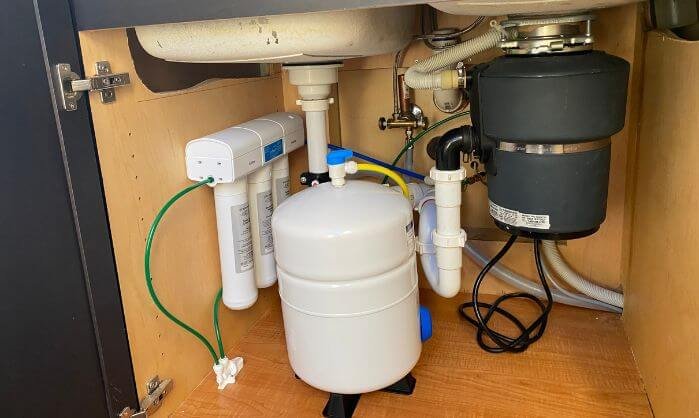
These systems often combine several stages, including sediment and carbon prefilters, the reverse osmosis membrane, and sometimes a post-treatment filter.
Because the membrane is doing significant work, maintenance matters. Filters and membranes have finite lifespans, and performance can decline when they aren’t replaced according to the system’s requirements.
Some systems also produce wastewater during operation, so efficiency is another factor worth considering before purchase.
Don’t Forget About Water Hardness
Hard water is primarily associated with calcium and magnesium.
It can leave white spots on dishes, deposits around faucets, and scale inside water heaters and appliances. A drinking-water filter may improve taste, but it won’t necessarily address hardness throughout the home.
If hardness is a major concern, whole-home treatment may be worth considering separately.
This is an important distinction because homeowners sometimes expect a kitchen filtration system to solve problems that are occurring throughout the plumbing.
The right system depends on where the problem occurs and what you’re trying to accomplish.
Filter Maintenance Isn’t Optional
A filter can only perform properly while its filtration media remains effective.
As a cartridge becomes saturated, water flow may decrease, and the system may no longer perform as intended. That’s why replacement schedules exist.
Keep track of installation and replacement dates. If your household uses a lot of water, filters may need attention sooner than a standard estimate suggests.
And don’t ignore sudden changes. If water begins tasting unusual after months of normal operation, check the filter before assuming something mysterious has happened to the source water.
Think About Convenience Before Buying
A filtration system should make life easier, not create another complicated household responsibility.
Consider where the system will be installed, how often filters need replacement, how easy those filters are to access, and whether replacement cartridges are readily available.
Under-sink systems can be excellent for targeted drinking-water treatment, but cabinet space can become tight. Countertop units are easier to access but take up visible space.
There isn’t one perfect arrangement. Choose the setup you’re realistically willing to maintain.
Don’t Let Marketing Decide for You
Words such as “advanced,” “premium,” and “maximum purification” can sound impressive. They don’t tell you whether a particular system is appropriate for your water.
Look for specific performance information instead.
What does the filter reduce? Under what conditions? How much water can it treat? What maintenance does it require? Is it certified for the claims being made?
Those questions are much more useful than simply counting the number of filtration stages.
Better Water Is About Confidence, Too
At the end of the day, filtered water isn’t only about taste.
It’s about knowing what you’re drinking and feeling comfortable filling a glass whenever you’re thirsty. It’s about making coffee without wondering why it tastes strange. It’s about cooking with water you trust.
The best approach starts with understanding your source water and identifying the concerns that actually matter.
From there, filtration can be selected around real needs rather than assumptions. Maybe a simple carbon filter is enough. Maybe a multi-stage system makes more sense. Perhaps another form of treatment is appropriate altogether.
There’s no need to make the process more complicated than it is.
Find out what’s in the water, decide what you want to improve, choose equipment that matches those goals, and keep it maintained.
That’s a much more sensible path to better-tasting, dependable drinking water — and one you won’t regret a few months after installation.