A water treatment system can look like a fairly simple purchase from the outside. You compare a few models, look at prices, read some reviews, and choose the one that seems to offer the most.
But water isn’t one-size-fits-all.
The water entering a small apartment, a large family home, and a property supplied by a private well may have completely different characteristics. Even two houses on the same street can have different concerns because of plumbing, usage patterns, or equipment already installed.
That’s why the best treatment setup isn’t necessarily the biggest or most expensive one. It is the one that makes sense for the water, the property, and the people living there.
Start With the Problem, Not the Product
When homeowners notice an issue, the first instinct is often to search for a product that promises to fix it.
Water tastes odd? Buy a filter.
White scale appears around the faucet? Get a softener.
There’s sediment? Add another cartridge.
Sometimes those solutions work. Sometimes they don’t, because the original problem wasn’t clearly identified.
A better starting point is to ask a few basic questions. What has changed? Does the issue affect one faucet or the whole house? Is it present in hot water, cold water, or both? Has the water source changed? When was the existing equipment last serviced?
Those details can narrow down the possibilities before any equipment is purchased.
Every Home Has Different Water Needs
Water treatment should reflect actual household conditions.
A family with several bathrooms and heavy daily water use may need more capacity than a couple living in a smaller home. A property with hard well water may require different pretreatment than a home supplied by municipal water.
Even the layout of the plumbing matters.
That’s where system customization can become valuable. Rather than installing equipment based on a generic package, a properly planned system can account for water chemistry, flow requirements, available space, household demand, and treatment goals.
Customization doesn’t necessarily mean complicated equipment. In some cases, it simply means choosing the right size and placing the components in the right order.
Testing Gives You a Better Starting Point
Water testing is one of the simplest ways to replace assumptions with information.
A useful test may provide information about hardness, pH, iron, manganese, sediment, or other characteristics depending on the type of analysis performed. For private wells, more comprehensive testing may be appropriate based on local conditions and potential contamination concerns.
Testing can also prevent unnecessary treatment.
If your biggest complaint is taste, but the actual issue is related to a specific characteristic of the water, the right filtration method may be quite different from what you initially expected.
There’s no benefit in treating something that isn’t a problem.
Installation Is More Than Connecting Pipes
Even a high-quality treatment system can perform poorly if it’s installed incorrectly.
Flow direction matters. Connections need to be secure. Valves must be configured properly. Tanks and filters require adequate space. Some equipment needs access to drainage or electrical power.
Poor installation can also create headaches later when maintenance is required.
That’s why expert installation & maintenance can make a meaningful difference. A knowledgeable technician can assess the installation location, configure the equipment correctly, explain how it works, and identify potential problems before they become expensive repairs.
It’s not the most exciting part of buying a water system, admittedly. But it’s one of the parts you’ll appreciate later.
Think About Water Pressure Before Installation
Water pressure is easy to overlook.
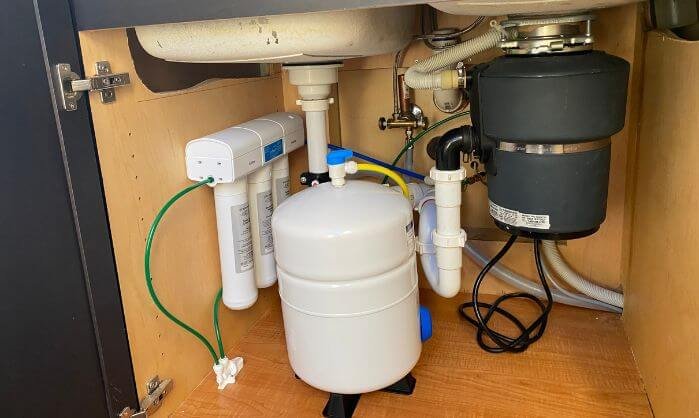
Some treatment equipment requires sufficient pressure to operate effectively. Reverse osmosis systems, in particular, depend on pressure to move water through their membranes.
If your home already has weak pressure, adding equipment without considering that limitation may make the problem more noticeable.
A professional assessment can help determine whether the treatment system is compatible with the existing plumbing. In some situations, additional equipment or a different configuration may be appropriate.
The point is simple: don’t assume the water system exists in isolation. It becomes part of your home’s plumbing network.
Taste Is Often What Gets People Interested
Most homeowners don’t start researching water treatment because they love reading about filtration technology.
They start because the water tastes strange.
Maybe there’s a chlorine-like flavor. Perhaps the water tastes metallic, flat, or simply different from bottled water. Sometimes the problem appears only after plumbing work or a change in the municipal supply.
Taste isn’t a complete measure of safety, but it is a legitimate reason to investigate water quality.
Appropriate filtration can address certain taste and odor concerns. When the treatment is correctly matched to the cause, the result can be noticeable without requiring an overly complicated setup.
For many households, enhanced taste is one of the most immediately appreciated benefits of a well-planned drinking-water system.
Don’t Ignore the Water You Can’t See
Taste isn’t the only consideration.
Hardness may leave scale. Sediment may collect in aerators. Iron can contribute to staining. Certain dissolved substances won’t change the appearance of water at all.
This is why clear water isn’t necessarily proof that everything about the water is ideal.
If you’re considering treatment, look at the entire picture rather than focusing on what you can see in a glass.
Whole-Home and Point-of-Use Treatment Have Different Jobs
A common mistake is expecting one treatment system to handle every household concern.
Whole-home treatment can address certain characteristics before water reaches showers, laundry areas, appliances, and faucets. Point-of-use treatment, meanwhile, can focus on water used for drinking and cooking.
Neither is automatically superior.
If hard water is affecting the entire plumbing system, an under-sink filter won’t solve the scale problem in your bathroom. On the other hand, if taste is your primary concern, treating every gallon entering the house may not be necessary.
Choosing between the two starts with understanding what you’re trying to accomplish.
Maintenance Keeps the System From Becoming Invisible
A treatment system can quietly become part of the house. That’s convenient, but it can also make maintenance easy to forget.
Filters need replacing. Softener systems may require salt and inspection. Reverse osmosis membranes have service intervals. Connections should be checked periodically.
Put maintenance dates somewhere you’ll actually see them.
A calendar reminder works. So does a note on the refrigerator. The method doesn’t matter much; consistency does.
When maintenance is neglected, performance can slowly decline. By the time you notice the change, the equipment may already have been struggling for months.
Don’t Be Afraid to Ask What You Are Paying For
Before purchasing a system, ask for clear answers.
What does it remove? What does it not remove? How often do filters need replacement? What are the ongoing costs? How much space does installation require? What happens if the system develops a problem?
A reputable provider should be comfortable answering those questions without burying you in technical language.
If you don’t understand what you’re buying, it’s difficult to know whether you’re getting good value.
A Good System Should Make Life Simpler
Water treatment is successful when it solves a real problem without creating five new ones.
The equipment should fit the household. Maintenance should be manageable. Replacement parts should be accessible. Installation should be done correctly, and the system should have enough capacity for normal demand.
Most importantly, expectations should be realistic.
No treatment technology does everything. Understanding those limits is part of choosing wisely.
The Best Setup Is the One You Don’t Have to Think About Constantly
A properly planned water treatment system should eventually fade into the background.
You shouldn’t have to wonder every morning whether the softener regenerated. You shouldn’t be constantly checking whether the drinking-water filter is working. You shouldn’t be dealing with recurring leaks because the original installation wasn’t done carefully.
Instead, the system should quietly do its job.
That starts with understanding the water, identifying the actual problem, choosing suitable technology, and planning for maintenance from the beginning.
The right setup may be sophisticated, or it may be surprisingly simple. What matters is that it fits.
When equipment is selected around real household needs rather than sales claims, water treatment becomes less of a complicated project and more of a practical improvement — one that makes everyday routines a little easier, a little cleaner, and perhaps even more enjoyable.